

 +44-74-1148-3554





Review Article - Journal of Environmental and Occupational Health (2026)
Artificial Intelligence Based Surveillance for Real-Time Occupational Hazard Detection in High-Risk Industries: Implications for Waste Management
Dr. Eboniece Cason*Dr. Eboniece Cason, Safety and Emergency Services, Columbia Southern University, Alabama, United States, Email: eboniece.cason@columbiasouthern.edu
Received: 28-Apr-2026, Manuscript No. JENVOH-26-189122 ; Editor assigned: 30-Apr-2026, Pre QC No. JENVOH-26-189122 (PQ); Reviewed: 14-May-2026, QC No. JENVOH-26-189122; Revised: 21-May-2026, Manuscript No. JENVOH-26-189122 (R); Published: 28-May-2026
Abstract
Keywords
Artificial intelligence; Occupational health surveillance; Digital public health; Waste management; Injury prevention
Introduction
Occupational injury and illness remain leading contributors to preventable morbidity and mortality, with disproportionate risk concentrated in safety sensitive and labor intensive industries. In the United States, waste and recyclable materials collection is consistently ranked among the most hazardous occupations, with fatality rates markedly exceeding national workforce averages [1,2]. Transportation related incidents, including struck by events and vehicle collisions, account for the majority of deaths in this sector, underscoring the persistent danger of mobile and roadside work environments [1].
Despite incremental reductions in fatality rates in recent years, waste collection work remains associated with injury and death rates approximately an order of magnitude higher than the average U.S. occupation [2]. These disparities reflect sustained exposure to interacting hazards such as heavy manual handling, large vehicle operation, uncontrolled public environments, and contact with biological and chemical agents [3,4].
Conventional occupational health surveillance systems, including injury logs, workers’ compensation claims, and periodic inspections, remain essential for regulatory compliance but function largely as retrospective or lagging indicators. Such systems are poorly suited to capturing dynamic risk in real time, particularly in industries characterized by variable routes, changing environments, and short cycle tasks. Consequently, opportunities for primary prevention are frequently missed.
Artificial Intelligence (AI) enabled surveillance systems offer a shift toward continuous and predictive risk detection. Through the integration of sensor derived data and machine learning analytics, AI supports near real time identification of hazardous conditions and unsafe behaviours [5,6]. From a public health perspective, this transition aligns with epidemiologic principles emphasizing early intervention and population level prevention. This viewpoint examines core AI based occupational surveillance applications and considers their relevance, benefits, and ethical implications for the waste management industry.
Literature Review
Relevant literature was identified through a targeted narrative review of publications indexed in OVID, PubMed, and Google Scholar. Searches focused on studies examining the application of artificial intelligence within the waste and industrial sectors, including technologies related to occupational health. A lower temporal boundary of 1975 was applied to capture the chronological development of occupational disease detection methods and technological solutions used in industrial settings. Articles were selected based on relevance to the topic rather than adherence to formal systematic review criteria.
AI-Based occupational surveillance as digital public health infrastructure
AI based occupational surveillance integrates continuous data collection with algorithmic analysis to identify risk patterns preceding injury or illness. Common data streams include wearable biosensors, vehicle telematics, environmental sensors, and computer vision systems deployed in workplaces and vehicles [7]. Machine learning models analyze these data to detect deviations from baseline exposure or behavioral patterns associated with increased injury risk.
Unlike traditional surveillance methods, AI enabled systems offer high temporal resolution and contextual sensitivity, enabling detection of transient and cumulative risks that static assessments often overlook. Importantly, these systems should be conceptualized as decision support tools that enhance occupational health expertise rather than replace professional judgment [5]. When framed as prevention-oriented infrastructure, AI based surveillance aligns with digital public health approaches increasingly emphasized in population health research.
Figure 1 illustrates AI-based occupational surveillance as a digital public health system that integrates multimodal data inputs and analytics to support prevention-oriented decision making.
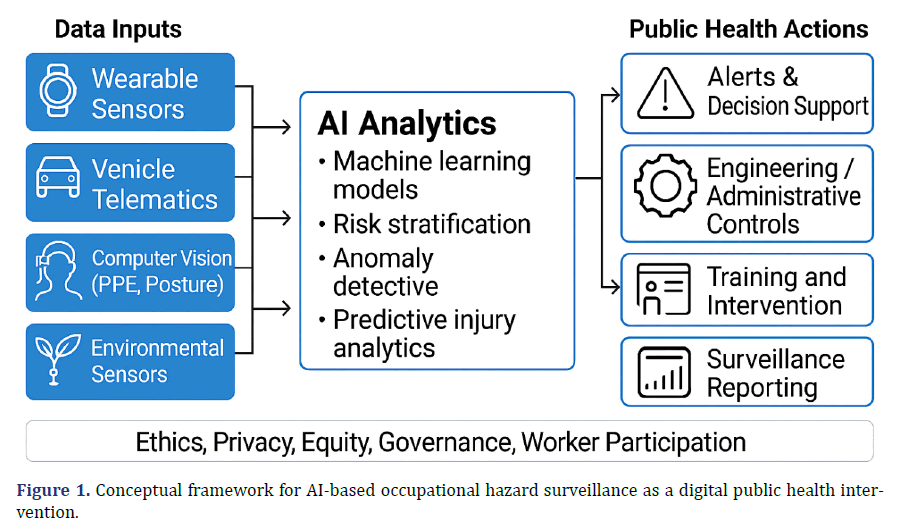
Figure 1: Conceptual framework for AI-based occupational hazard surveillance as a digital public health intervention.
Multimodal data inputs, including wearable biosensors, vehicle telematics, computer vision, and environmental sensors are integrated through machine learning analytics to detect fatigue, unsafe behaviors, PPE noncompliance, and elevated injury risk in real time. Outputs function as decision-support signals for occupational health professionals, enabling preventive public health actions such as alerts, engineering controls, training, and surveillance reporting. Ethical governance, equity, transparency, and worker participation are embedded across all system layers.
Core applications of AI-Based occupational surveillance
Fatigue and cognitive risk detection: Fatigue is a well-established determinant of occupational injury, particularly in work involving prolonged driving, early morning schedules, and physically demanding labor. AI enabled fatigue detection systems integrate physiological indicators, behavioral metrics, and task level performance data to assess fatigue risk in near real time [7,8]. Compared with proxy measures such as hours worked, AI driven approaches enable individualized exposure assessment and targeted intervention.
From an occupational epidemiology perspective, real time fatigue monitoring represents a shift toward dynamic exposure assessment, reframing fatigue as a modifiable occupational hazard rather than an unavoidable characteristic of certain jobs.
PPE compliance and unsafe act monitoring: Computer vision-based AI systems are increasingly deployed to detect PPE usage, unsafe postures, and proximity to moving equipment. Studies suggest that these systems can enhance compliance beyond what is achievable through periodic safety audits alone [6,9]. However, continuous observation introduces concerns regarding worker privacy and autonomy, emphasizing the need for transparent governance and participatory implementation.
Predictive injury analytics: Predictive models integrating historical injury data, near miss reports, task characteristics, and environmental conditions allow organizations to stratify injury risk across jobs, locations, and time periods [7,8]. While promising, such models require rigorous epidemiologic validation to avoid spurious associations, misclassification, and unintended inequitable impacts. Predictive analytics should be deployed as decision support systems rather than deterministic predictors of injury.
Applications in the waste management industry: The waste management sector presents a uniquely complex occupational risk profile characterized by mobile operations, heavy vehicle interaction, manual material handling, and exposure to biological and chemical hazards. AI based surveillance technologies are increasingly adapted to these conditions.
AI enabled vehicle telematics systems analyze driving behavior, route complexity, and fatigue indicators to identify elevated collision risk and support real time intervention [10]. Motion tracking systems and wearable sensors can identify unsafe lifting mechanics and cumulative ergonomic strain, supporting musculoskeletal injury prevention [9,11]. Computer vision-based PPE detection and environmental monitoring systems further support exposure prevention in settings where direct supervision is limited [6,12].
Together, these applications demonstrate the potential for AI based surveillance to address gaps left by conventional occupational health monitoring approaches in the waste sector.
Discussion
Ethical, legal and equity considerations
The prevalence AI based occupational surveillance raises significant ethical challenges. Continuous monitoring may undermine worker trust if perceived as punitive or disciplinary rather than protective. Concerns regarding data ownership, secondary use, and surveillance creep are particularly salient in lower wage and frontline occupations [11,13].
Algorithmic bias represents an additional risk. AI models trained on incomplete or skewed datasets may disproportionately classify certain worker groups as “high risk,” reinforcing existing occupational inequities [13]. Addressing these concerns requires governance frameworks grounded in transparency, proportionality, informed consent, and human oversight. Occupational health professionals play a critical role in ensuring that AI systems align with prevention and equity goals rather than productivity surveillance.
Implications for public health research and practice
AI based occupational surveillance should be understood as a digital public health intervention. Future research priorities include prospective evaluations linking AI deployment to injury and illness outcomes, standardized reporting of algorithm performance, and assessment of psychosocial impacts associated with continuous monitoring. Advances in explainable AI and privacy preserving methods may further support ethical integration into occupational health practice [5].
Conclusion
AI enabled surveillance systems offer a transformative opportunity to shift occupational hazard detection from retrospective documentation to proactive prevention. In high risk industries such as waste management, real time fatigue detection, PPE monitoring, and predictive injury analytics may substantially reduce preventable injury. Realizing this potential requires rigorous epidemiologic validation, ethical governance, and sustained worker engagement. When implemented responsibly, AI can strengthen rather than erode the public health mission of occupational health surveillance.
References
- Bureau of Labor Statistics. Census of fatal occupational injuries summary, 2023. U.S. Dep Labor 2024.
- Bureau of Labor Statistics. Census of fatal occupational injuries summary, 2024. U.S. Dep Labor 2026.
- Resource Recycling. MRF and collection worker deaths climbed in 2023. 2025.
- Waste Dive. Waste and recycling collection was fourth deadliest occupation in 2023: BLS. 2024.
- Shah IA, Mishra S. Artificial intelligence in advancing occupational health and safety: An encapsulation of developments. J Occup Health 2024;66(1):uiad017.
[Crossref] [Google Scholar] [Pubmed]
- Park J, Kang D. Artificial intelligence and smart technologies in safety management: a comprehensive analysis across multiple industries. Appl Sci 2024;14(24):11934.
- Armenteros-Cosme P, Arias-Gonzalez M, Alonso-Rollan S, Marquez-Sanchez S, Carrera A. Advancements in artificial intelligence and machine learning for occupational risk prevention: A systematic review on predictive risk modeling and prevention strategies. Sensors (Basel) 2025;25(17):5419.
[Crossref] [Google Scholar] [Pubmed]
- Ozobu CO, Adikwu FE, Odujobi NO, Onyekwe FO, Nwulu EO. Advancing occupational safety with AI-powered monitoring systems: A conceptual framework for hazard detection and exposure control. World J Innov Modern Tech 2025;9(1):186-213.
- Fontaine B. How Artificial Intelligence Is Reshaping Occupational Health and Safety.
- Fatigue Science. AI in occupational health: The current and future landscape for safetyâ??sensitive industries. Mining Health Safety 2026.
- El-Helaly M. Artificial intelligence and occupational health and safety, benefits and drawbacks. Med Lav 2024;115(2):e2024014.
[Crossref] [Google Scholar] [Pubmed]
- Surveily. AI safety solutions for the waste management industry. 2026
- Fisher E, Flynn MA, Pratap P, Vietas JA. Occupational safety and health equity impacts of artificial intelligence: A scoping review. Int J Environ Res Public Health 2023;20(13):6221.
[Crossref] [Google Scholar] [Pubmed]
Citation: Cason E (2026) Artificial Intelligence Based Surveillance for Real-Time Occupational Hazard Detection in High-Risk Industries: Implications for Waste Management, J Environ Occup Health Volume: 16, Issue: 02